
Hagan Criminal History Checks
A Hagan search works best as a five-office sequence. The official service material does not support a claim that one city database holds reports, bookings, court filings, and statewide history. First identify the event and the agency. Keep the date, place, report or citation number, and name spelling used on the paperwork. Ask for a precise existing record, not a broad compilation. The responding agency may have a releasable incident entry even when an active investigation keeps narratives or evidence closed.
- Identify Hagan Police, Evans County Sheriff, or GBI as the responding agency.
- Ask that agency for its report custodian and current written-request method.
- Use the current Hagan municipal counter for a city citation or ordinance matter.
- Check Evans Magistrate, State, or Superior Court based on the case stage.
- Use GCIC self-inspection or Georgia Felon Search for the appropriate statewide layer.
A name-only result is not biometric proof. Compare dates and case numbers, and use fingerprints when identity must be certain. A city report may describe an allegation that was later changed or dismissed.
Hagan Police Service Map
The 2024 Georgia Department of Community Affairs service-delivery strategy records a police and law-enforcement arrangement between Hagan and the Evans County Sheriff. Older official service material also described Hagan as maintaining police. Those sources matter because they show that small-city events should not be assigned to the sheriff by assumption. The citation, incident card, officer name, or agency number should control the first request.
The official joint comprehensive-plan page provides visual context for that shared service structure. 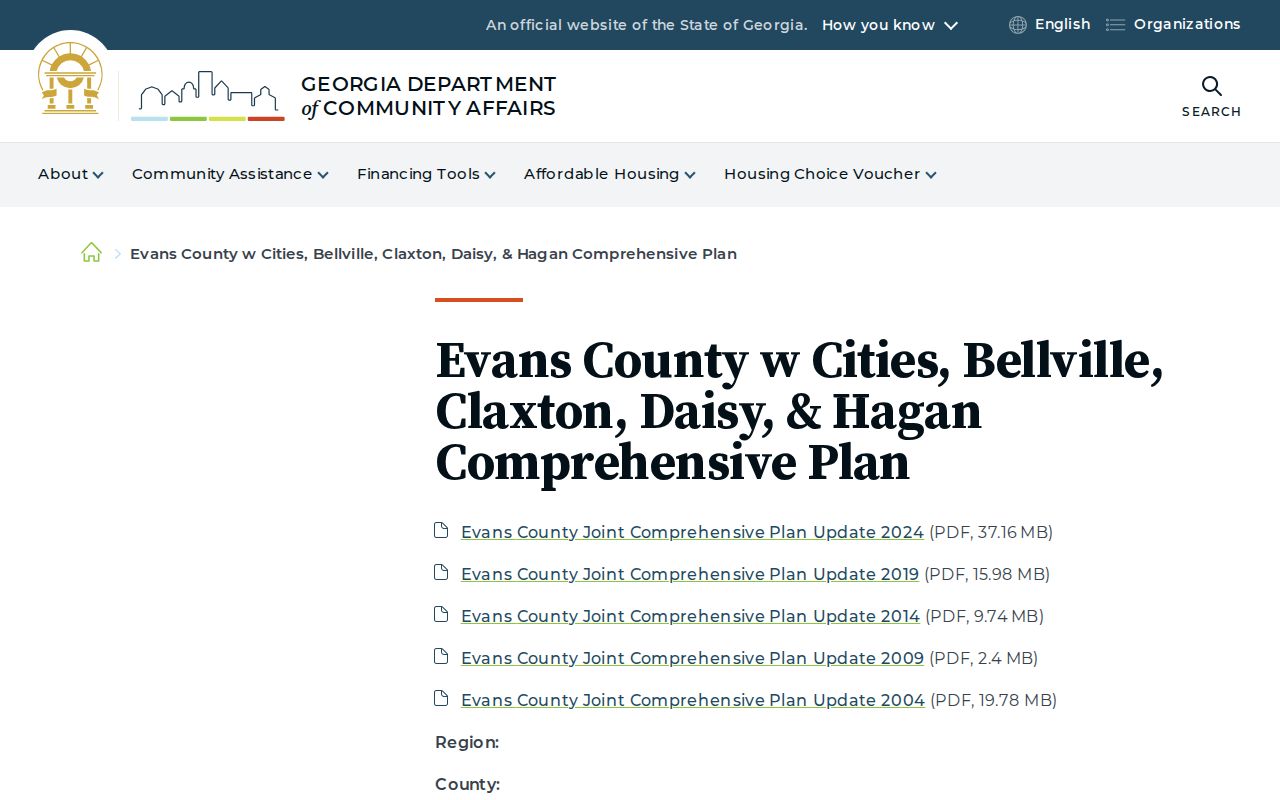 The plan helps explain why a Hagan event can produce records in both city and county hands.
Records at Hagan Police
When Hagan Police responded, request the city-created incident or arrest report from the current city records custodian. Research did not verify a current Hagan website, police records phone, street address, email, hours, fee table, form, arrest log, app, or online portal. Do not send sensitive identity documents to an address found on an unofficial directory. Instead, locate the current municipal counter through an official Georgia city or court directory and confirm the custodian before submitting anything.
A focused request should state the date, time range, location, report number if known, and exact item sought. Ask for electronic native format when practical and a cost estimate before work passes a chosen limit. If another agency assumed the investigation, Hagan may hold only its initial response while that agency holds later evidence. That split is normal record ownership, not a missing file.
No Hagan Criminal Record Portal
No verified Hagan report portal, municipal case search, booking log, or mass name-search database was located. The useful fallback is a counter-and-phone chain. Ask the current city office who keeps Hagan Police records. For custody coordination, call the Evans County Sheriff at 912-739-1611. For general county routing, the Evans County contact office can direct a caller through option 2 for public safety or option 3 for courts.
Those calls confirm where to send a request; they do not guarantee a phone search. No city fee, turnaround, or identification rule should be assumed. A requester should document whom they spoke with and the date because the current custodian or booking arrangement may change.
Note: A failed web search has little value when no official Hagan mass-search system exists.
Booking and Arrest Records in Hagan
Hagan Police or the sheriff creates the arrest-side record. The holding facility creates the booking record. Official Evans County examples repeatedly show Tattnall County Jail as the booking site, but the research does not establish that every Hagan arrest goes there. Call the sheriff to confirm current custody before contacting Tattnall. Booking county and arrest county can differ without an error.
The agency report states alleged facts and arrest authority. A booking entry centers on intake, entered charges, bond, holds, and release. Neither proves guilt. For a filed result, follow the matter to Evans County court records through the Evans County arrest search pathways and the clerk.
Hagan Cases Split by Court
A Hagan city citation or ordinance issue may remain at a municipal counter. Evans Magistrate Court issues arrest warrants and handles first appearances and bond proceedings. Misdemeanor and traffic prosecutions can proceed in Evans State Court, while felony prosecution belongs in Superior Court. The office that issued or filed the record is the best source for that stage.
The Georgia Courts E-Access directory lists Evans State Court, but not Evans Superior Court. An account or provider access may be required. Exact case-number format can also cause a false negative. The Evans clerk at 123 West Main Street, Claxton, holds Superior, State, and Juvenile filings and expressly allows no phone-in or write-in searches. Call 912-739-3868 only to confirm counter details, not to request a remote name search.
The Hagan Municipal Court File
No current Hagan municipal portal, form, fee, contact, or docket interface was independently verified. Confirm the present counter through an official municipal-court directory. Ask whether the document is a city citation, ordinance case, warrant-related entry, or a matter transferred to an Evans County court. Never infer that a municipal file does not exist merely because it is absent from State Court e-access.
| Court Name | Current Hagan municipal court or designated city counter; verify before visiting |
|---|---|
| Case Types Heard | City citations and ordinance matters within current municipal authority |
| Case Lookup Channel | Clerk or counter request; no verified public portal |
| What the Docket Shows | Ask for citation, filing, hearing, plea, judgment, and disposition entries that exist |
| Copies & Fees | No verified Hagan schedule; request a current estimate |
If the counter refers the matter to Evans State or Superior Court, use the case number and party spelling supplied by the city. This prevents duplicate searches and helps distinguish the city matter from the later prosecution.
Hagan Records in a Small City
The 2020 Census profile counted 959 Hagan residents, making Hagan the second-largest incorporated city in Evans County. That scale helps explain the absence of a verified public mass-search portal, but it does not erase city record ownership. The key question remains who created the record.
Small-city access often depends on a precise request and a confirmed custodian. Broad requests can sweep in records held by police, courts, or another investigative agency. Narrowing the date, place, and record type makes the correct handoff easier and reduces the risk of paying for an unhelpful search.
How Hagan Records Reach County
A Hagan incident can move through several systems. Police records describe the response. Magistrate entries may document a warrant, first appearance, or bond step. A prosecutor may later change the charge before filing in State or Superior Court. GCIC receives fingerprint arrest data and later reported dispositions, but reporting lags or missing outcomes can make statewide results incomplete.
Record flow: Hagan PD › Evans County Courts › Georgia Bureau of Investigation, Georgia Crime Information Center
Recent activity is usually clearest at the originating agency and court. The court file is best for the judicial outcome. For a broader personal record, GCIC self-inspection is more complete than the public Georgia Felon Search, which is a paid felony-conviction product and omits misdemeanors, nonconvictions, restricted matters, and successful First Offender matters.
When a Hagan Search Fails
First check spelling, date of birth, agency, and case-number format. Then ask whether the matter is still an agency report, a municipal citation, a Magistrate entry, or a filed State or Superior case. Georgia Felon Search returns only a narrow statewide subset, so no result does not prove there was no arrest or case.
Work backward from the most concrete item. A citation may identify the city counter and charge. A booking number can identify the holding facility. A State Court result may reveal the filing number used by the solicitor. For a felony or older matter absent online, inspect the Evans clerk file in person. Ask whether a scanned attachment is omitted from the public index before concluding the document is gone. If the arresting agency still has no reported disposition, take the certified or filed court outcome to that agency rather than asking GCIC to decide what a court did.
If a statewide record is wrong, obtain the Evans court disposition and use the GBI correction process. Do not buy repeated name searches to resolve identity uncertainty. Fingerprint-based inspection is the stronger route for the subject's own record.
Hagan Open Records Deadlines
The Georgia Open Records Act requires agencies to respond within three business days when records are available. For records that cannot be produced in that period, the response should state timing and cost. This is not an absolute three-day completion promise for a large file or one requiring lawful redaction. Ask for segregable, nonexempt parts and the precise Code provision for each withholding.
The first quarter-hour of administrative work is generally free. Later labor can use the lowest-paid qualified employee rate, and prepayment can be required when estimated cost exceeds $500. The agency need not create a new report, but existing electronic fields remain records.
Hagan Record Access Rules
Access depends on the record and its status. Open court dockets and releasable police records may be inspected, while active investigations, juvenile material, victim data, full dates of birth, Social Security numbers, medical details, and protected addresses may be withheld or redacted. Record restriction limits dissemination; it does not always destroy every agency or court copy.
Key Statutes:
Georgia Open Records Act, O.C.G.A. §§ 50-18-70 through 50-18-77 sets the public-request framework and response duties.
O.C.G.A. § 35-3-35 governs access to and dissemination of Georgia criminal history information.
O.C.G.A. § 35-3-37 provides Georgia's record-restriction and correction framework.
Use the originating office for the official copy. Keep the request and response so any later court or GCIC correction can be tied to the right source.